Why Most Marketing Strategies Fail Before They Start (And How to Build One That Doesn't)
Why Most Marketing Strategies Fail Before They Start (And How to Build One That Doesn't)
I'm going to say something that might sting a little.
That marketing strategy you spent three weekends building? The one with the colorcoded spreadsheet, the content calendar, the fivestep funnel? There's a good chance it was doomed before you ever hit publish on anything.
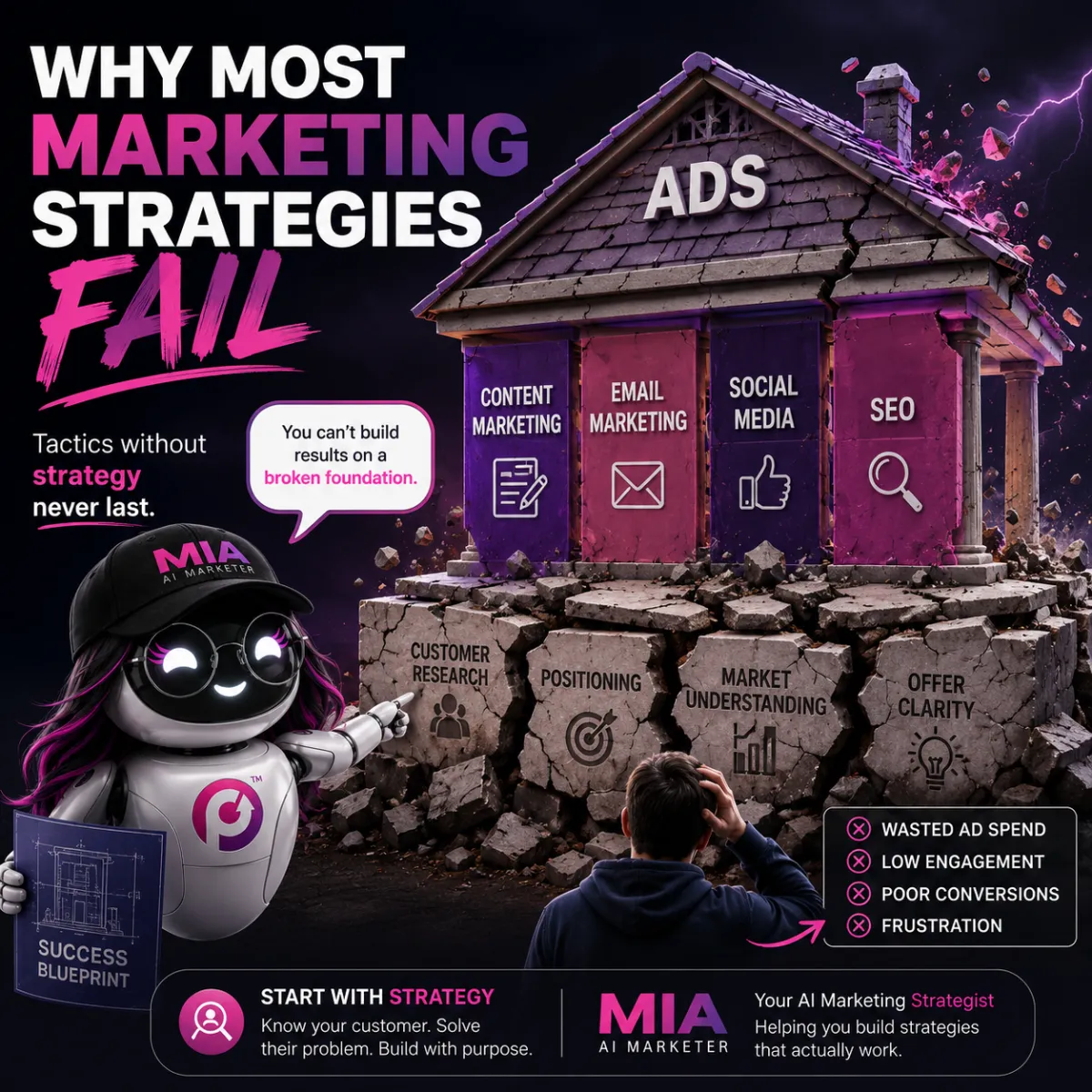
Not because you're bad at marketing. Not because your product isn't good. But because most of us build strategies the same backwards we jump straight to doing things before we've figured out the one thing that actually matters: why anyone should care.
I've watched smart, hardworking business owners burn through ad budgets, churn out content for months, and still end up wondering why nothing stuck. And almost every time, the problem wasn't the execution. It was that the foundation was never laid.
We're All Guilty of Skipping the Boring Part
Here's how it usually goes. You decide it's time to get serious about marketing. You watch some videos, maybe join a few communities, and you come away with a list of things you should be doing. Post consistently. Run Google ads. Build an email list. Use the best AI tools for marketing to speed everything up.
So you get moving. You find an ad copy generator, throw together a lead capture page, pick an email drip sequence template someone shared in a Facebook group, and start. You're busy. You feel productive.
But three months later, you've got a handful of subscribers who never open your emails and ad spend that went nowhere. What happened?
You skipped the boring part. The research. The real, uncomfortable digging into who your customer actually is and what they genuinely need, not what you assume they need.
That's where strategies die. Not in the execution. Right there, at the beginning, when we're too excited to slow down.
Know Your Market Better Than They Know Themselves
The businesses that consistently win at marketing aren't always the most creative ones. They're just the most informed. They know exactly who they're talking to, what that person is afraid of, what they've already tried, and why it didn't work.
Getting there used to mean months of surveys and research. Now, AI market research tools can compress a lot of that legwork helping you spot patterns in what your audience is saying, where your competitors are dropping the ball, and what kind of messaging actually lands. A good AI marketing assistant isn't there to replace your thinking. It's there to make your thinking sharper.
But here's what I want to be clear about: the tool doesn't do the strategy. You do. The tool just helps you get there faster.
Your Brand Is Either Building Trust or Quietly Destroying It
People make snap judgments. You already know this. If your logo looks like clip art and your color scheme is giving "2011 WordPress theme," it doesn't matter how good your product is, something feels off, and people leave.
Brand design AI has genuinely made this accessible for small businesses. You can generate a logo with AI, get your fonts and colors sorted, and end up with something that looks like you actually thought about it. AI tools for logo design have come a long wayan AI brand logo generator today can give you a starting point that a real designer can refine, or that honestly works asis for a lot of use cases.
This isn't about being flashy. It's about looking like you take yourself seriously, so your customers can too.
Content That Sounds Like a Human Wrote It (Because One Should)
Here's my honest issue with a lot of AI content marketing tool output: it's fine. It's grammatically correct, it's structured, and it says absolutely nothing that makes you stop scrolling.
The stuff that actually works the blog posts people share, the emails people reply to, the case studies that close deals it has a point of view. It's a little messy sometimes. It admits things. It doesn't hedge every single sentence.
Use a case study template free resource to document a real client win, but write it like you're telling a friend the story over coffee. Here's what was broken, here's the weird thing we tried, here's what actually happened. A good template for a case study gives you the structure but the voice has to come from you.
Same goes for lead magnets. Lead magnet templates free tools give you the bones. What makes someone actually download it and use it is whether it solves a specific problem they're already losing sleep over.
Capture Leads Like You Want Them to Stick Around
A lead capture form that asks for eight fields of information is not a formit's an interrogation. Keep it simple. Name, email, done. Your lead capture page should do one job: make the value of signing up obvious, and make the act of signing up effortless.
AI for lead generation and AI lead generation tools can help you test, optimize, and qualify but the fundamentals still apply. Less friction. Clearer value. One ask at a time.
Emails That Don't Feel Like Emails
The nurture emails examples I see most often from small businesses read like press releases. Formal, distant, weirdly corporate for a company with six employees.
Your email nurture sequence template should be a starting point, not a script. The best drip sequence I've ever seen was basically just a business owner writing like they'd write to a colleague, here's something useful, here's what I'm seeing, here's a question I'd love your take on. That's it. Open rates through the roof.
An email drip sequence works when it feels like a person is behind it. Because one should be.
Ads for People Who Don't Have Big Budgets
Google ads for small business can absolutely work but not when you're targeting everyone and hoping for the best. A free ad copy generator or free AI ads generator gives you a starting draft, but the targeting, the offer, the landing page those are what actually determine whether you make money or donate it to Google.
Generate ads with AI to move faster. But think carefully about who sees them and what you're asking them to do next.
Start With a Conversation, Not a Spreadsheet
Tools like Mia at ProfitLifteran AI marketing strategist built for real business owners exist because strategy shouldn't require a consultant retainer or a 40page workbook. You answer some questions, it helps you think through the gaps, and you walk away with actual direction instead of a vague plan you'll never follow.
The best free AI marketing tools aren't the ones that do everything for you. They're the ones that help you think more clearly so when you do take action, you're building something that actually has a shot at working.
Start there. Not with the tactics. With the thinking.
