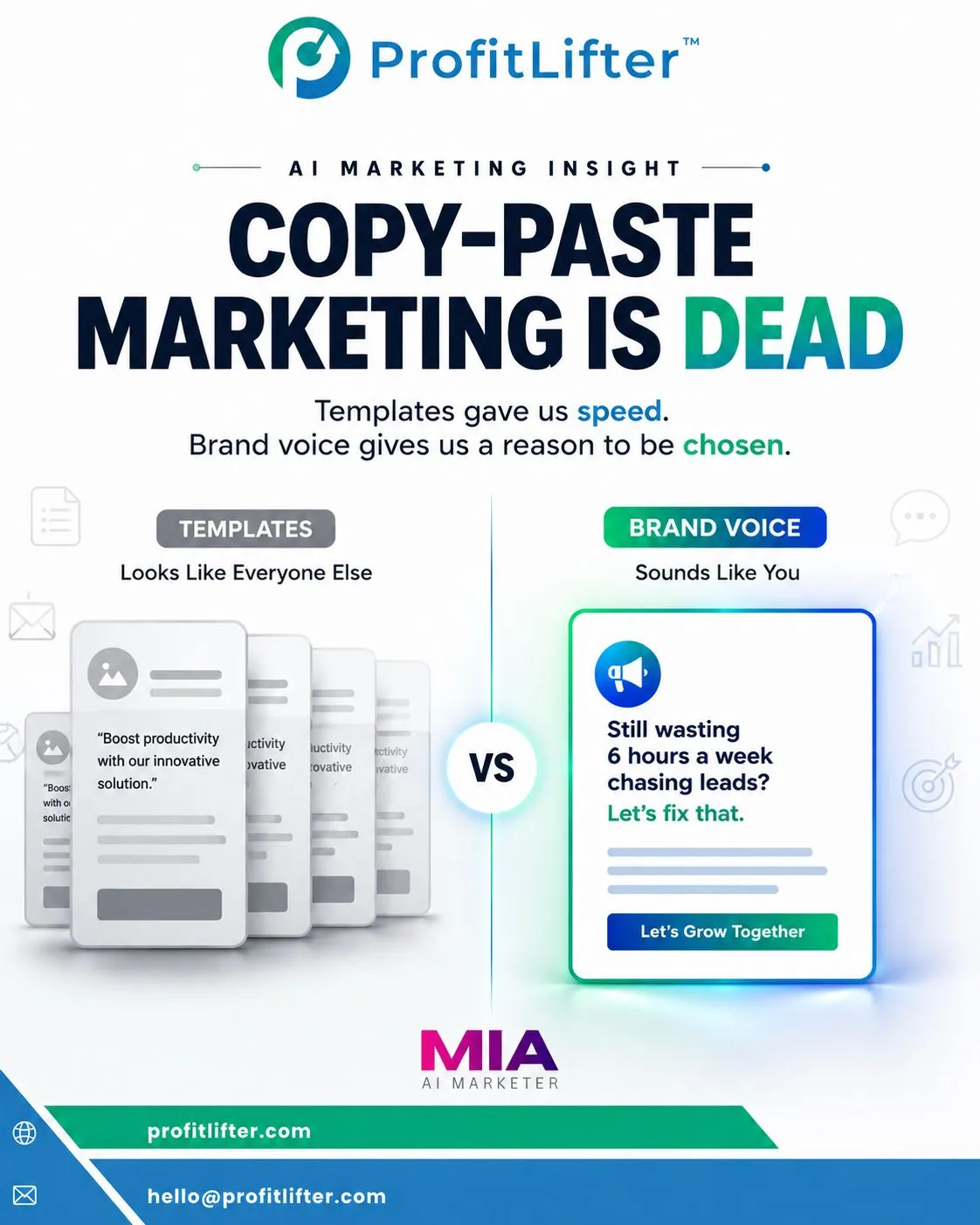
Brand Voice vs. Templates: Why Copy-Paste Marketing Stopped Working
Brand Voice vs. Templates: Why Copy-Paste Marketing Stopped Working
There was a moment, not so long ago, when templates felt like a superpower. A free email nurture sequence template here, a case study template free for download there, a lead magnet you could fill in over a single coffee and suddenly a one-person marketing team could move like a whole department. Speed was the entire point, and templates delivered it.
Then everyone got the same templates. And the superpower quietly turned into a liability.
This is a piece about that shift: why the copy-paste era of marketing is ending, what's quietly replacing it, and why your brand voice not the template you started from is becoming the thing that actually moves the numbers.
The template boom was real, and it worked
Let's be fair to templates, because they earned their reputation. For years, the fastest way to ship marketing was to borrow a proven structure and pour your details into it. Need to warm up a list? Grab a nurture sequence and study a few nurture emails examples to get the rhythm right. Need social proof? A template for a case study turned a messy customer win into a clean, repeatable asset. Need conversions? Lead magnet templates free on every blog meant you never had to design a checklist from scratch.
The same logic spread into every corner of the funnel. An ad copy generator could produce ten headline variants before you finished your sentence. A free ad copy generator meant small teams could test messaging without a copywriter on staff. You could create a logo with AI in an afternoon and look like you'd hired an agency.
For a while, this was a genuine unlock. The barrier to "looking professional" collapsed. And when only some businesses were using these shortcuts, the shortcut itself was an edge.
Then the whole internet started to sound the same
Here's the problem with a shortcut everyone takes: it stops being a shortcut and becomes the baseline.
When the same free AI marketing tools hand the same starting point to ten thousand businesses, you don't get ten thousand distinct brands. You get ten thousand variations of the same brand. A google ad copy generator trained on "best practices" nudges everyone toward the identical headline formula. An AI brand logo generator produces marks that feel interchangeable the moment you put three of them side by side. Open any inbox and you'll find a dozen welcome emails that read like they were assembled from the same five blocks because they were.
The math is brutal. The more accessible a template is, the less it can differentiate you, precisely because accessibility is the thing that made it spread. Free ad copy generator output is "free" in more ways than one: it costs you nothing, and it's worth roughly that much in attention, because your prospect has seen the same phrasing from your competitor this week.
Copy-paste marketing didn't fail because the templates were bad. It failed because it succeeded too widely.
Templates optimize for output. Brand voice optimizes for recognition.
This is the distinction that matters, and most teams still miss it.
A template optimizes for output getting a deliverable out the door that's structurally correct. That's useful, but structure is the commodity layer. Anyone can produce a structurally correct email.
Brand voice optimizes for recognition the feeling a reader gets that this could only have come from you. It's the specific way you explain things, the jokes you'd make and the ones you wouldn't, the promises you're willing to put in writing. Recognition is what survives the scroll. It's the difference between a prospect thinking "another vendor" and "oh, them."
Templates can't carry voice, because voice is the part that resists being templated. The instant a phrase becomes a fill-in-the-blank, it stops sounding like a person and starts sounding like a form.
What actually changed: AI got good at voice, not just volume
For a long time, AI and automation in marketing was a volume game. More variants, more sends, more landing pages, faster. The promise of early AI for marketing automation was essentially "do the boring parts at scale," and the output was generic by design because the model had no idea who you were.
That's the part that's changed. Modern AI can be trained on your past content, your positioning, your customers' actual words, and your founder's way of talking and then generate inside those constraints. The frontier is no longer "generate ads with AI." It's "generate ads with AI that sound like us and would never be mistaken for anyone else."
This quietly rewrites how you should judge tools. The top AI marketing tools used to compete on how many templates they shipped. The best AI marketing tools now compete on how well they learn and protect a voice. That's a different product entirely. A bigger template library is just a bigger box of sameness; the real value is an engine that adapts to you instead of asking you to adapt to it.
What brand-voice-first marketing looks like across the funnel
The shift isn't abstract. It changes the concrete artifacts at every stage.
At the top, lead capture stops being a form and starts being a first impression. A lead capture page or lead capture form built from a generic template converts on autopilot fine, but forgettable. When AI for lead generation is tuned to your voice, the same page reads like the start of a relationship rather than a tollbooth. The strongest AI lead generation tools don't just optimize the button color; they make the language of capture feel like the rest of your brand. Done well, lead generation AI raises conversion and qualification at the same time, because the people who opt in already recognize who they're opting into.
In the middle, nurture stops sounding borrowed. Instead of dropping prospects into a recycled email nurture sequence template, voice-first automation writes the sequence the way you'd write it on your best day consistent, specific, unmistakably yours across every touch. The best nurture emails examples you'll ever study are the ones your own audience can't tell were automated.
At the bottom, ads stop blending in. A free AI ads generator that produces the same google ads for small business as every other small business is a race to the average. A voice-aware AI Facebook ad generator, by contrast, scales your hooks without flattening them the volume of automation, the distinctiveness of a human.
And your brand assets stop looking stock. Brand design AI and AI tools for logo design are genuinely useful for speed, but if you generate an AI logo with zero inputs about who you are, you'll get something that looks like everyone else who did the same. Used as a starting point that's then shaped to your story, the speed is a gift. Used as a finish line, it's how you end up indistinguishable.
How to choose tools in the post-template era
If sameness is the disease, your tool selection is part of the cure. A simple test cuts through the noise: does this tool impose a template on me, or does it learn from me?
When you're evaluating free AI tools for marketing, look past the feature count. Plenty of free AI marketing tools advertise "100+ templates" as if that's an advantage but in a copy-paste world, a template count is a sameness count. The better question is whether the tool ingests your voice, your offers, and your audience before it writes a word. AI marketing tools free of that capability are fine for a first draft and dangerous as a final one. The genuinely useful ones treat your brand as the input, not an afterthought you paste in at the end.
Where this leaves you
The teams winning right now aren't the ones who abandoned automation that would be giving up the speed that templates rightly earned. They're the ones who kept the speed and added back the voice. They use AI to remove friction, not to remove themselves.
That's the thinking behind how MIA approaches this. Rather than handing you another stack of templates to fill in, MIA learns your business and builds your complete marketing strategy in one conversation capture, nurture, ads, and messaging all aligned to the way you actually sound. The automation does the heavy lifting; your voice stays the constant.
Copy-paste marketing stopped working for a reason worth remembering: in a world where everyone can produce the same thing instantly, the only durable advantage is sounding like no one else. Templates gave us speed. Brand voice gives us a reason to be chosen. The next era of marketing belongs to the teams who refuse to pick just one.
