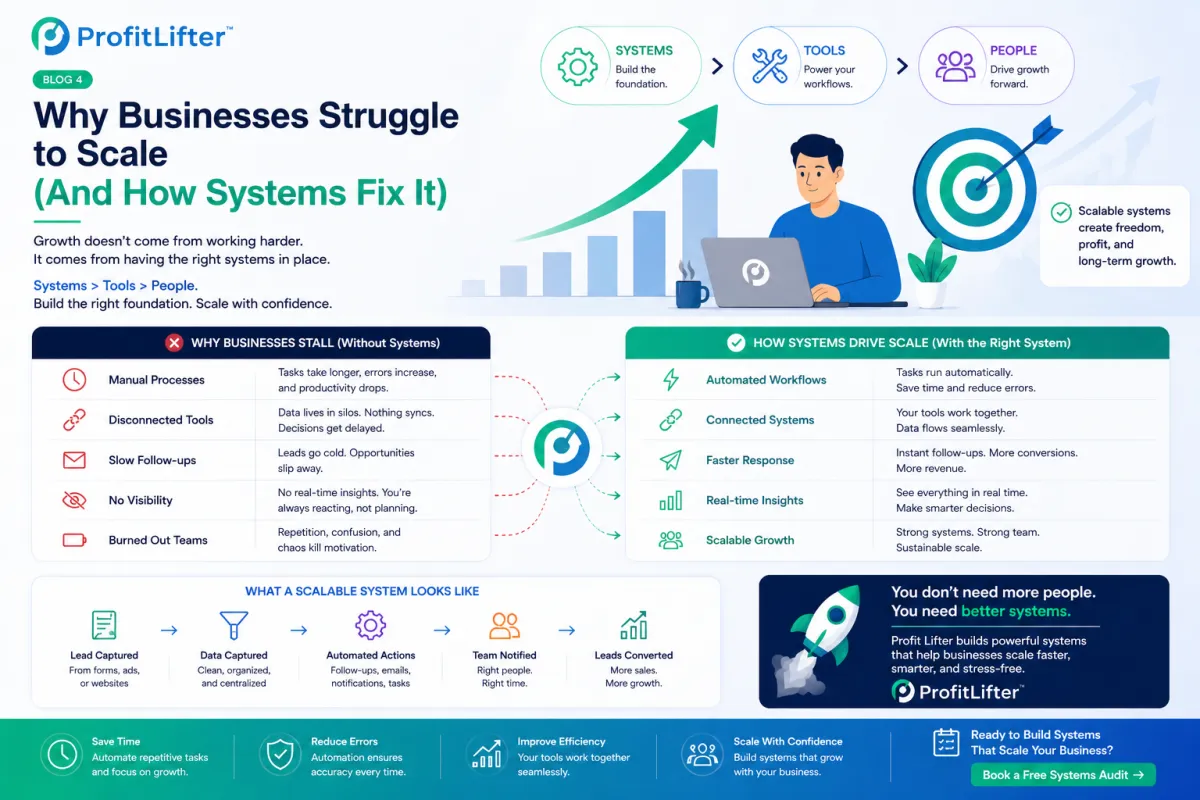
The Real Reason Most Small Businesses Struggle to Scale Their Sales
Meta Description:
It is not the offer. It is not the market. Most small businesses fail to scale because their sales system was built for a business half the size of where they want to go.
Most small business owners believe that growth comes from better marketing. More leads, stronger campaigns, and higher ad spend.
Marketing does matter. But in many cases, it is not the real problem.
The real issue starts after the lead arrives. What happens next determines whether that lead turns into revenue or disappears. And this is where most small businesses fall short.
Marketing Automation CRM
When leads start coming in, they should be handled with speed, consistency, and structure. But in most small businesses, the process is scattered.
Some leads get immediate attention. Others wait for hours or even days. Some are followed up manually by the owner. Others are assigned to a VA. A few are handled through email tools that are not fully connected to the CRM.
This lack of structure creates inconsistency. Out of every 100 leads, only a small percentage receive the full follow up experience that was originally planned.
A proper marketing automation CRM solves this by bringing everything into one system. Every lead is captured, tracked, and responded to in a uniform way. There is no confusion about where a lead is or what should happen next.
Instead of relying on memory or manual effort, the system ensures that every action is triggered automatically.
Marketing CRM Automation
As businesses grow, manual processes begin to break. What worked for 20 leads per month does not work for 200.
This is where marketing CRM automation becomes essential.
Automation ensures that every lead receives a response within a defined time frame. It also ensures that follow ups continue even if the lead does not respond the first time.
More importantly, automation allows personalisation without increasing workload. The system can track where the lead came from, what they interacted with, and how they behaved. Based on this, it sends relevant messages instead of generic ones.
Without automation, businesses rely on human effort for repetitive tasks. This leads to delays, missed follow ups, and inconsistent communication. With automation, the process becomes predictable and scalable.
Service Automation in CRM
A strong system does not stop at sending messages. It also manages how work flows inside the business.
This is where service automation in CRM plays a key role.
Once a lead shows interest, the system can assign tasks automatically. It can notify a VA or a sales representative. It can move the lead into the correct stage of the pipeline. It can track every interaction without requiring manual updates.
This creates clarity for the team. Anyone picking up the conversation knows exactly what has already happened. There is no need to start from zero or search across multiple tools.
Service automation reduces confusion and saves time. It ensures that human effort is used only where it matters most, which is in meaningful conversations with qualified leads.
Why Most Businesses Get Stuck
Many businesses believe they have automation in place, but the reality is different.
Their systems are built on multiple tools connected through integrations. When one tool changes, the connection can break. Automations stop working, but the issue often goes unnoticed until leads start slipping away.
This creates a hidden problem. On the surface, everything looks fine. But underneath, the system is leaking opportunities.
Businesses try to fix this by adding more leads. But more leads do not fix a broken system. They simply increase the number of lost opportunities.
Building a System That Can Scale
A scalable business is built on consistency.
Every lead should receive a response within the same time frame. Every follow up should happen as planned. Every stage of the pipeline should be clearly defined.
This level of consistency is only possible when everything is connected.
Platforms like Profit Lifter are designed to bring CRM, automation, communication, and task management into one place. This removes the gaps between tools and ensures that the system works as a single unit.
When there are no gaps, leads do not fall through. When processes are automated, follow ups do not get missed. When everything is visible in one place, decisions become easier.
Fix the System Before You Scale
If your sales feel inconsistent, the answer is not to push harder on marketing.
Instead, look at your system.
Are leads being followed up immediately
Are follow ups happening automatically
Is your team able to access complete lead information
Can your system handle more volume without extra manual work
If the answer to any of these is no, your system needs attention.
Fixing the system creates a strong foundation. Once that foundation is in place, scaling becomes much easier and more predictable.
Conclusion
Small businesses do not struggle because they lack effort or ideas. They struggle because their systems are not designed for growth.
A disconnected setup leads to missed opportunities, inconsistent follow ups, and wasted marketing spend.
By implementing a proper marketing automation CRM, supported by marketing CRM automation and service automation in CRM, businesses can create a system that handles growth without breaking.
When the system works, scaling stops feeling difficult. It becomes a natural outcome of a well structured process.
Frequently Asked Questions
Q: Why do more leads not automatically increase sales
A: Because without a structured system, many leads are not handled properly. A marketing automation CRM ensures consistent follow up.
Q: What is the biggest issue in most sales systems
A: Inconsistency. Leads are handled differently depending on time, workload, or manual effort.
Q: How does marketing CRM automation help
A: It ensures that every lead receives timely and relevant communication without relying on manual work.
Q: What does service automation in CRM do
A: It manages internal workflows, assigns tasks, and keeps all lead information organised in one place.
Q: Can a small team handle more leads with automation
A: Yes. With the right system, a small team can manage high lead volume efficiently without hiring more people.
